
By Dr. Arvind Jagdish Dubey (PhD)
Managing Editor, investigationpost.com/ | BhartiyaAbroad.com
A2 milk has become a familiar premium product in India’s urban dairy market. It is sold through specialist dairies, supermarkets, direct-to-consumer websites and quick-commerce platforms. Packaging often features indigenous cattle, farm imagery and claims about easier digestion or better health. The A2 label can add to the price of milk, ghee, curd and other dairy products. Yet the meaning of that label is not always explained with the care that a food claim requires.
The question is not whether A1 and A2 beta-casein variants exist. They do. The question is what a seller is entitled to claim on the basis of that difference, what testing supports the claim, and whether the presentation leads consumers to believe that a product has been certified by the government or proven to provide a health benefit.
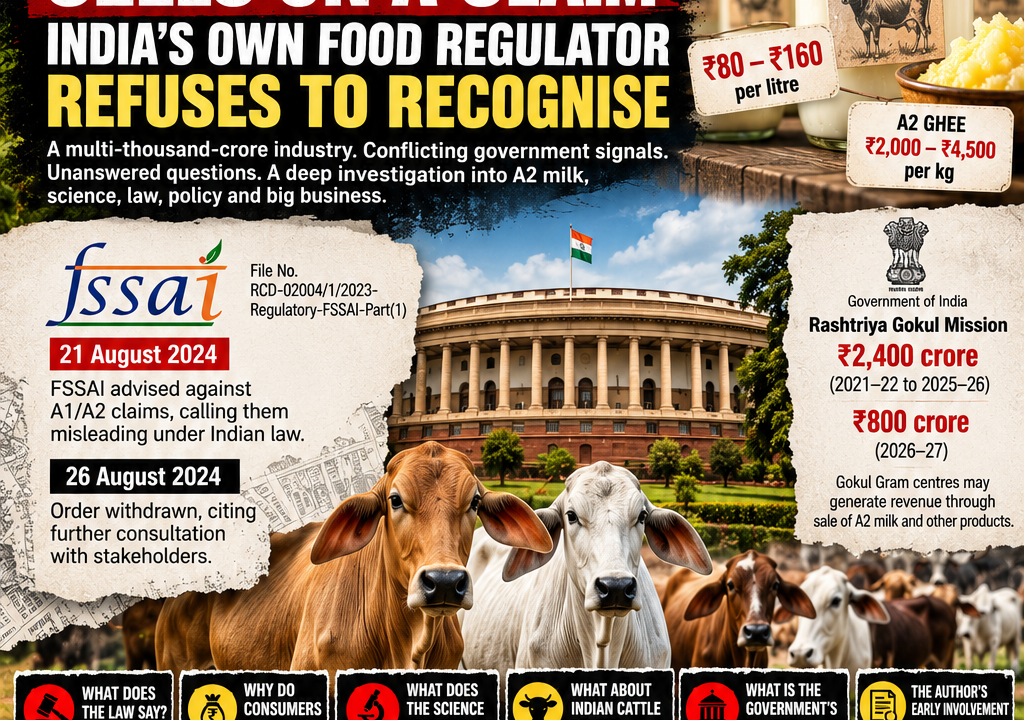
The Food Safety and Standards Authority of India (FSSAI) addressed the labelling issue in August 2024. It said that the existing food-product standards did not recognise an A1/A2 distinction and directed food businesses to stop using such claims. Five calendar days after the date on the original document, FSSAI withdrew the clarification, citing the need for further consultation and engagement with stakeholders.
That reversal did not settle the science. It did not establish that every A2 claim was unlawful, and it did not amount to official approval of every claim made by sellers. It left an important regulatory question open: how should a food business describe a protein variant without turning a genetic distinction into a broader promise about health, purity or government certification?
The issue matters to consumers paying a premium, to farmers investing in particular breeds, to dairy businesses competing for market share and to public authorities responsible for food standards. It also matters to the credibility of regulation. When a national regulator issues a strong clarification and withdraws it days later, the public should be able to find out what changed, what consultation followed and what rules now apply.
The FSSAI advisory: what the document said
The FSSAI advisory was dated 21 August 2024 and was publicly reported on 22 August. It was titled “Clarification regarding Selling/Marketing of Milk & Milk products such as Ghee, Milk etc in the name of A1 & A2.” The official document carried File No. RCD-02004/1/2023-Regulatory-FSSAI-Part(1).
The advisory stated that the distinction between A1 and A2 beta-casein was not recognised under the Food Safety and Standards (Food Product Standards and Food Additives) Regulations, 2011. It referred to the existing standards for milk and milk products and said that the use of A1/A2 claims, including claims on milk-fat products, could mislead consumers. It directed food business operators to remove the claims from packaging and marketing, including online listings. It also allowed existing pre-printed packaging to be exhausted within six months.
The document raised a practical concern. A product may display a valid FSSAI licence or registration number, but that number does not necessarily mean the regulator has separately tested or certified every claim made on the package. If a consumer sees an A2 badge beside a licence number, the presentation may create an impression of official endorsement that the licence itself does not provide.
On 26 August 2024, FSSAI issued a second document titled “Withdrawal of Clarification regarding Selling/Marketing of Milk & Milk products such as Ghee, Milk etc in the name of A1 & A2.” It carried the same file number. The withdrawal stated that the earlier clarification “stands withdrawn for further consultation and engagement with the stakeholders.”
The dates on the two documents are five calendar days apart. Some descriptions of the episode have called the documents “unnumbered.” That is inaccurate: both carry the file reference set out above. They did not, however, provide a detailed public account of the consultation process, identify a timetable for its completion or set out the conclusions that would follow.
That distinction is important to the credibility of the investigation. A strong report should not build its case on an incorrect description of the documents. The file number is part of the record. The unanswered question is what happened after the withdrawal and whether the consultation produced a clear, public regulatory position.
What withdrawal does—and does not—mean
The August advisory should not be described today as a continuing blanket prohibition. FSSAI withdrew it. A withdrawn clarification is not a court judgment, and the withdrawal itself did not decide the scientific merits of A1 and A2 milk.
At the same time, the withdrawal should not be treated as a certificate of approval for A2 claims. The wording cited consultation and stakeholder engagement as the reason for withdrawal. It did not say that all A2 labels had been tested, that the regulator had accepted all health claims, or that a new A2 standard had been notified.
The careful conclusion is narrower: FSSAI issued a substantive clarification about claims that it considered unrecognised or misleading under the existing standards, then withdrew that clarification for further consultation. The public material reviewed for this article does not identify a later A1/A2-specific amendment that conclusively resolves the labelling question. Nor does it establish that no internal consultation took place. A public record can show what has been published; it cannot, without further evidence, prove that no internal work exists.
The distinction also matters to enforcement. Food businesses need to know what evidence they must keep for a claim, what wording is permitted, whether a test must be conducted on the milk or the herd, and how to avoid implying that a licence is an endorsement of a health benefit. Consumers need to know whether “A2” means a tested beta-casein profile, a description based on the breed of the animal, or simply a marketing term.
The law on food labels and misleading claims
The Food Safety and Standards Act, 2006 provides the central statutory framework for food safety in India. Several provisions may be relevant to A2 labelling, but they serve different purposes and should not be treated as interchangeable.
Section 18 sets out general principles of food safety. Section 23 deals with packaging and labelling of pre-packaged food. Section 24 addresses restrictions on misleading advertisements and unfair trade practices. The applicable regulations also govern how food may be described and what claims can be made.
The original advisory referred to the Act and the Labelling and Display Regulations, 2020. It is inaccurate to say that Section 18(1)(a) specifically contains every rule governing labels, packaging and advertising. A legal assessment should identify the actual provision, regulation and wording relevant to the claim in question.
Nor does the absence of a particular subsection citation automatically prove that an advisory is invalid. The legal question would depend on the authority invoked, the applicable regulations, the content of the direction and the circumstances in which it was issued. A claim that the advisory was unlawful would require more than pointing out that the document did not cite a particular section.
The more practical question is whether a seller can substantiate the claim. A statement that a product contains A2 beta-casein is different from a statement that the product prevents disease, is easier to digest, is organic, contains no antibiotics or is officially certified. Each claim carries a different meaning and requires appropriate evidence.
A valid FSSAI licence number is not, by itself, an A2 certificate. It does not automatically verify breed, genetic status, the composition of a particular batch or a health benefit. If marketing creates the impression that FSSAI has certified those matters, the presentation deserves scrutiny.
The regulator should clarify the distinction between a descriptive claim, a compositional claim and a health claim. A clear rule would protect consumers while also giving compliant businesses a consistent basis for labelling and testing.
The government’s cattle policy and the A2 question
The Rashtriya Gokul Mission was launched to conserve and develop indigenous bovine breeds. Government material on the Gokul Gram model has listed the sale of A2 milk among possible revenue-generating activities, alongside breeding animals, semen, biogas, organic manure, vermicompost and other products.
That reference is relevant. It shows that A2 milk sales were contemplated as one possible source of income for these centres. But it does not establish that every Gokul Gram sells A2 milk, that A2 sales are the principal revenue source for these facilities, or that the entire Rashtriya Gokul Mission depends on the sale of A2 products. Those stronger claims require centre-level accounts, operating reports or other evidence of actual revenue.
The ₹2,400-crore figure often cited in this debate was the total Rashtriya Gokul Mission outlay for the five-year period 2021–22 to 2025–26. It was not a budget exclusively for A2 milk. The government’s published Output-Outcome Monitoring Framework lists an RGM outlay of ₹800 crore for the 2026–27 financial year. Neither figure should be described as public expenditure “on A2 milk” without a budget line or expenditure record that specifically supports that description.
A further parliamentary record is relevant. Rajya Sabha Unstarred Question No. 2946, titled “Promotion of Indigenous Cow Breeds and A2 Milk Certification,” was answered on 18 March 2026. The response discussed the Rashtriya Gokul Mission, livestock traceability and initiatives related to genetic merit and breed purity. It did not expressly identify a national A2 milk certification standard in the answer.
That omission gives Parliament, journalists and consumers a concrete question to put to the government: does it intend to establish a public standard for A2 labelling and certification, and what testing and traceability requirements would apply? The wording of a single parliamentary answer is not conclusive proof that no certification or testing arrangement exists anywhere. It is, however, a useful record against which the government’s position can be clarified.
The evidence supports a question about coordination between food regulation and livestock policy. It does not yet prove that one ministry legally requires A2 sales while another currently bans them. A fair investigation should state the policy tension without claiming a direct legal contradiction that the documents do not establish.
The science: what A1 and A2 actually describe
A1 and A2 are variants of beta-casein, one of the proteins found in bovine milk. Milk contains water, fat, lactose, minerals and proteins. Caseins make up most of the protein fraction, and beta-casein is one of the casein proteins.
A key difference between the common A1 and A2 beta-casein variants is the amino acid at position 67 of the protein chain. The A1 variant has histidine at that position; the A2 variant has proline. Differences in the protein sequence can affect how the protein is broken down during digestion. Under some conditions, digestion of beta-casein can produce peptide fragments, including beta-casomorphin-7, commonly called BCM-7.
This biochemical difference is real. The debate concerns what it means for human health. A mechanism observed in a laboratory, an animal study or a biochemical model does not automatically establish a clinically meaningful effect in people who drink milk. The strength of a health claim depends on the quality, consistency and relevance of human evidence.
Some studies have investigated whether A1 and A2 milk differ in their effects on digestive symptoms. A systematic review of human studies found evidence of varying certainty. Some findings supported differences in digestive symptoms for some consumers, but the evidence for many other health outcomes was low or very low in certainty.
The available evidence does not justify presenting A1 milk as an established cause of heart disease, type 1 diabetes, autism or other chronic conditions. Such claims have circulated in public debate, often based on ecological comparisons between countries or proposed mechanisms involving BCM-7. Ecological comparisons cannot, on their own, establish that a particular milk protein caused a disease. Diet, genetics, lifestyle, health care, measurement methods and many other factors may differ between populations.
The same caution applies to claims that A2 milk is a proven treatment for lactose intolerance. Lactose is a sugar in milk; beta-casein is a protein. They are different components. A product’s beta-casein profile does not mean it is lactose-free, and a consumer’s symptoms cannot be attributed to one cause from a label alone.
The responsible conclusion is neither that the A1/A2 distinction is imaginary nor that it proves a broad set of health benefits. The variants can be identified. Research into digestive outcomes continues, and findings should be reported with their limitations. Claims about disease prevention or treatment require much stronger evidence than the mere presence of a protein variant.
Indian cattle genetics: high A2 prevalence, not a guarantee for every animal
Research on Indian indigenous cattle has reported a high frequency of the A2 allele in the populations studied. A 2022 study examining native cattle breeds reported an A2 allele frequency of about 0.95 across its sampled population. The study also identified A1A2 heterozygotes and a small number of A1A1 animals.
A separate 2023 study of samples from seven indigenous and two exotic breeds also reported a high frequency of A2A2 genotypes among the indigenous breeds it examined. These findings support the view that A2 is common in many Indian indigenous cattle populations.
They do not support a blanket claim that every indigenous animal is A2A2 or that the A1 allele has never been found in native cattle. Allele frequency is a population statistic. It does not guarantee the genotype of every animal, and a study’s findings apply to the animals and breeds sampled. Breed, herd and individual status should not be inferred without suitable evidence.
Buffalo genetics should also be handled carefully. A study of 657 buffaloes across four breeds reported A2A2 genotypes in all animals sampled. That is a meaningful result for the study population. It should not be turned into an unsupported claim about every buffalo in every country or population.
Claims that goat, sheep and camel milk are all “A2” require separate, species-specific evidence. The A1/A2 terminology most commonly discussed in this market relates to bovine beta-casein. It should not automatically be applied to all dairy species as though the same classification had been established in each.
An ICAR article published in Indian Farming in 2021 discussed the A1/A2 debate and Indian bovine genetics. It noted that concrete evidence of widespread health harm from A1 milk remained lacking and argued that there was no demonstrated health-evidence basis for a general shift to A2-only herds. That is an important qualification for farmers and policymakers.
If A2 is already common in many indigenous cattle populations, the key questions are how the claim is verified, whether testing is carried out on individual animals or milk batches, and what additional value the label provides to consumers. Breed identity alone may not prove the beta-casein genotype of an individual animal. A credible claim should explain the basis for verification rather than relying only on an image of a native cow.
What the 2018 milk-safety survey found
The FSSAI’s National Milk Safety and Quality Survey of 2018 tested 6,432 liquid milk samples. The final findings reported aflatoxin M1 above the permissible limit in 368 samples, or 5.7 per cent, and antibiotic residues above permitted limits in 77 samples, or 1.2 per cent. Twelve samples were reported adulterated with substances that rendered them unsafe.
The survey’s finding that more than 93 per cent of samples were considered safe for human consumption should not be rewritten as meaning that 93 per cent met every compositional or quality parameter. Safety and compositional quality are different measures. The survey also recorded non-compliance on quality parameters, and the two results should not be collapsed into a single “safe and compliant” figure.
Aflatoxin M1 is a serious food-safety concern. It can enter milk when animals consume feed contaminated with aflatoxins produced by moulds. Its presence does not, by itself, prove deliberate adulteration of milk. Feed quality, storage and animal management are relevant to controlling this risk.
The survey also identified antibiotic residues above permitted limits. Such findings point to the importance of veterinary oversight, observance of withdrawal periods after treatment, farm-level recordkeeping and testing. These are practical enforcement issues with direct implications for consumer safety.
The survey did not classify samples by A1/A2 beta-casein status. It therefore cannot be used to show that A2 milk is safer than A1 milk, or that an A2 label addresses the contaminants measured in the survey. A2 status is not a substitute for testing for aflatoxin, antibiotic residues, adulterants or hygiene-related risks.
The survey is relevant to this debate because it helps separate a market claim from a documented safety issue. If a company advertises A2 milk as healthier or safer, the public should be able to see what specific outcome is being claimed and what evidence supports it. Genetic status and food safety are not the same measurement.
The commercial market: prices, projections and proof
A2 products are sold at different prices depending on brand, city, pack size, animal source, processing method and production model. Liquid milk from a specialist farm is not directly comparable with packaged toned milk from a large dairy. Similarly, artisanal bilona ghee and conventional packaged ghee may differ in production method, scale and marketing as well as in their claims about beta-casein.
Commercial research firms publish different estimates of the size and growth of India’s A2 market. Their estimates use different definitions and methods. Such figures should be attributed to the firm and the date of publication, and should be presented as commercial estimates rather than official government statistics. Combining incompatible estimates into a single national figure can create a false impression of precision.
Mother Dairy has publicly discussed a target of building a ₹500-crore brand around its buffalo-milk variant, which the company described as containing A2 protein. That was a business projection, not proof that the target was achieved. Any report using the figure should identify it as a stated target and distinguish it from verified sales.
The same standard should apply to corporate claims about cash reserves, debt, market rankings, manufacturing arrangements and patents. A claim that a company has a particular amount of cash or no debt should be supported by a dated annual report or financial filing. Patent claims should identify the relevant patent numbers and explain what the patent covers. A patent relating to a testing method, for example, would not automatically establish ownership of the A2 protein variant itself.
A clear labelling framework would help both consumers and legitimate businesses. It could specify what evidence is needed to claim that milk contains a particular beta-casein variant, whether the claim is about an individual animal or a batch, what testing method is acceptable, and how a seller must word any health-related statement. Such a framework would not need to endorse exaggerated claims; it could instead make the basis of each claim visible.
International disputes and what courts have decided
The international commercial history of A2 milk includes disputes about labelling, trademarks and advertising. These disputes should be described with care because a case about a brand name is not necessarily a case about nutrition or health.
The a2 Milk Company and other dairy businesses have been involved in disputes in Australia and New Zealand. Where a case ended in settlement, the settlement should not be presented as a court finding on whether A1 milk causes disease or A2 milk produces a health benefit. A settlement may resolve commercial claims without a judge deciding the underlying scientific question.
Likewise, a trademark decision about whether “A2” is descriptive does not determine whether a milk product is healthier. Trademark law asks questions about distinctiveness, use and the scope of a mark. Food standards and clinical evidence raise different questions.
A Delhi High Court dispute involving Gujarat Cooperative Milk Marketing Federation and Akshar Foods and Beverages concerned claims that Amul milk was synthetic or adulterated. The court’s decision addressed unsubstantiated commercial allegations and should not be presented as a scientific trial of A1 versus A2 milk. It is relevant to the narrower principle that serious allegations about a food product require evidence.
Before publication, each international case should be checked against the original judgment, official case record or settlement documentation. The jurisdiction, parties, date, case number and outcome should be accurate. A timeline that mixes Australian proceedings with New Zealand decisions, or presents a settlement as a judicial ruling, risks undermining the rest of the investigation.
Dr. Arvind Dube’s early involvement in A2 milk discussions
Dr. Arvind Dube’s involvement in discussions around A2 milk dates back to 2014–2016. The documentary material identified for this article includes correspondence dated 18 November 2014 with Dr. Y.S. Rajput of ICAR-NDRI concerning a draft memorandum of understanding and two technologies, followed by an exchange dated 27 July 2016 with Andrew Clarke of The a2 Milk Company. The exchanges concerned Indian cattle breeds, A2 technology, genotyping and milk testing.
These records provide a documentary basis for examining Dr. Dube’s engagement with the subject before A2 products became a familiar feature of India’s retail dairy market. The records should be read for what they actually establish: participation in discussions, exchange of information and consideration of possible scientific or technical work. A correspondence trail should not be described as a completed agreement, a technology transfer or a commercial launch unless the relevant documents prove that outcome.
Dr. Dube’s position is that he was among the early people in India to bring the A1–A2 beta-casein issue into public discussion as a matter of science and policy, before the label became widely commercialised in retail markets. The documentary basis cited for examining that role includes the 2014 institutional correspondence, the draft MoU material and the 2016 exchange with an international A2 company representative. The chronology and the exact scope of his contribution should be assessed against the original records, rather than inferred from later market developments.
This article includes the section because the early correspondence forms part of the documented history of A2 discussions in India. It does not claim, on the basis of correspondence alone, that a particular commercial product, national standard or technology transfer resulted from those exchanges.
The questions that remain unanswered
The FSSAI withdrawal referred to further consultation and engagement with stakeholders. The public deserves to know whether that process has concluded. If it has, the regulator should publish its findings or explain the resulting policy. If it has not, the regulator should clarify the status and indicate what businesses are expected to do in the meantime.
The government should also clarify whether it intends to create an A1/A2-specific labelling, testing or certification framework. If such a framework is proposed, it should identify the scientific basis, the testing method, the treatment of mixed herds, the standards for batch-level claims and the distinction between genetic composition and health claims.
The authorities should explain how a food business can make an A2 claim without suggesting that a general FSSAI licence is a separate certificate of A2 status. The rules should also address advertisements that imply that A2 milk prevents disease or resolves lactose intolerance when the evidence does not support such a broad promise.
The Department of Animal Husbandry and Dairying should clarify how A2 milk sales are treated in Gokul Gram planning and reporting. If A2 milk is a possible revenue source, published accounts or performance reports could show whether centres actually earn income from it and how much. Such data would allow the public to distinguish a planning assumption from a demonstrated source of revenue.
Finally, sellers should be able to explain how their claims are verified. Does the product come from animals whose genotypes were tested? Is the claim based on breed, herd-level testing or a sample of the milk itself? How frequently is testing repeated? What happens when animals are introduced into a herd or when milk from different sources is mixed? These are practical questions that a credible certification or traceability system should answer.
Conclusion: the label needs evidence, and the rules need clarity
The records do not justify either extreme: that all A2 marketing is unlawful, or that the A2 label is a government-backed guarantee of better health. A1 and A2 are recognised beta-casein variants. Research indicates that A2 is common in many Indian indigenous cattle populations, and some studies have reported A2A2 genotypes in the buffaloes they sampled. Those findings do not prove that every animal has the same genotype or that the label guarantees superior safety or nutrition.
The scientific evidence on health outcomes is mixed and varies in certainty. Some studies have investigated digestive symptoms, but the evidence does not support sweeping claims that A1 milk causes chronic diseases or that A2 milk is a treatment for lactose intolerance. The 2018 national milk survey measured other safety and quality concerns; it did not test samples for A1/A2 status.
FSSAI’s August 2024 advisory was withdrawn for further consultation. The public material reviewed for this article does not show a final A1/A2-specific regulatory settlement. Government documents have contemplated A2 milk sales as one possible source of revenue for Gokul Grams, but the ₹2,400-crore Rashtriya Gokul Mission outlay was not a budget exclusively for A2 milk.
The next step should be straightforward: publish the outcome of the consultation, clarify the applicable rules, and explain what testing and evidence are required for A2 claims. Consumers should be able to distinguish a tested genetic description from a health promise or a claim of government certification. Farmers and businesses should be able to understand the rules before investing in a market built around the label.
A premium label is not proof by itself. The evidence behind it should be visible, and the rules governing it should be clear.
Key documentary references
- FSSAI, “Clarification regarding Selling/Marketing of Milk & Milk products such as Ghee, Milk etc in the name of A1 & A2,” dated 21 August 2024, File No. RCD-02004/1/2023-Regulatory-FSSAI-Part(1): https://fssai.gov.in/upload/advisories/2024/08/66c6d771eac97Advisory%20A1%20%26%20A2%20Milk%20%26%20Milk%20products.pdf
- FSSAI, “Withdrawal of Clarification regarding Selling/Marketing of Milk & Milk products such as Ghee, Milk etc in the name of A1 & A2,” dated 26 August 2024, same file number: https://fssai.gov.in/upload/advisories/2024/08/66cc48ad66e44New%20Doc%2008-26-2024.pdf
- Food Safety and Standards Act, 2006, particularly Sections 18, 23 and 24: https://www.indiacode.nic.in/bitstream/123456789/13658/1/food_safety_and_standards_act%2C_2006.pdf
- Rajya Sabha Unstarred Question No. 2946, “Promotion of Indigenous Cow Breeds and A2 Milk Certification,” answered 18 March 2026: https://sansad.in/getFile/annex/270/AU2946_ZLf4Jg.pdf?source=pqars
- 2022 cattle genetics study, “Demographic pattern of A1/A2 beta casein variants indicates conservation of A2 type haplotype across native cattle breeds (Bos indicus) of India”: https://pubmed.ncbi.nlm.nih.gov/35845115/
- Systematic review of human studies on A1/A2 beta-casein and health outcomes, PubMed PMID 30722004: https://pubmed.ncbi.nlm.nih.gov/30722004/
- FSSAI, National Milk Safety and Quality Survey 2018, final report and related official survey material.
- ICAR, Indian Farming (2021), article discussing the A1/A2 milk debate and Indian bovine genetics.
- Government material on Rashtriya Gokul Mission and Gokul Gram revenue activities, together with the 2026–27 Output-Outcome Monitoring Framework.
- Delhi High Court, Gujarat Cooperative Milk Marketing Federation Ltd. & Anr. v. Akshar Foods and Beverages & Anr., CS(COMM) 314/2021, decision dated 4 August 2022.
Editorial verification note: Market-size estimates, retail prices, corporate financial claims and specific international case histories should be included only where a dated primary source or clearly attributed research report is available. The consumer-survey percentages in the earlier draft have not been retained because no underlying report, sample size or methodology was provided.
#DrArvindDubeReports | @DubeReports